Nixonized U.S. currency
Inherent ViceNixonized U.S. currency is counterfeit American money bearing Richard Nixon’s image, discovered in shipping containers full of cash at a site associated with the Golden Fang. Its exquisite engraving and uncertain circulation make it at once a possible financial instrument, a government operation, and an absurd political omen: the image seems to arrive before its public source, while the law governing whose portrait may appear on U.S. currency turns the bills into a joke about Nixon’s mortality.
Discovery and Appearance
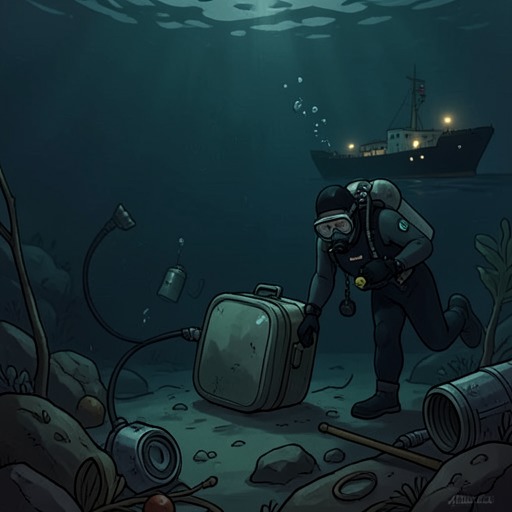
Sauncho reports that he has spent a day and night aboard a heavily equipped Justice Department vessel with federal agents, visiting the place where the Golden Fang was supposed to have left a lagan. Divers bring up one connex after another, each packed with shrink-wrapped U.S. currency. The scale of the recovery suggests a substantial and organized movement of money, but the find does not resolve who sent it, who was meant to receive it, or why it was left there.
The bills are counterfeit regardless of denomination: instead of the familiar portraits of Washington, Lincoln, Franklin, and other figures, each bears Nixon’s face. The engraving is so finely executed that observers speculate about an elaborate foreign origin. Nixon’s expression is itself described as oddly alarmed and unfocused, as though he were reacting to something outside the frame. That distinctive likeness later becomes crucial when Doc sees the same expression on television.
Competing Explanations and Uses
The find prompts several incompatible accounts rather than a settled explanation. Sauncho’s intelligence contacts say the CIA had commonly placed Nixon’s face on counterfeit North Vietnamese bills, dropping millions during bombing raids in an effort to destabilize the enemy’s currency. That precedent makes the Nixon portrait intelligible as an instrument of covert economic warfare, but it does not explain why the same treatment appears on counterfeit U.S. money.
Other observers suggest that Chinese Communist pranksters made the bills to undermine the dollar. Their reasoning rests on the finesse of the engraving, which they take as evidence of an elaborate foreign provenance, not on a confirmed identification of the printers. Another account holds that the notes may already have circulated as scrip in Southeast Asia and might even be negotiable in the United States. Collectors’ value offers a further possible use, while the suggestion that someone could spend a large quantity before the public noticed treats the counterfeits as an opportunity as well as a threat. The competing theories leave the money’s origin and practical status unresolved.
Legal Paradox and Political Meaning
Sauncho points to a rule that a person must be dead before appearing on U.S. currency. His conclusion is deliberately speculative: if the Nixon bills could count as legal tender in any universe, then Nixon would have to be dead in that universe. He reads the portrait as sympathetic magic, an attempt by someone to place the president among the departed. Doc answers that this interpretation does little to narrow the field of possible perpetrators, then asks to take some of the bills.
The image’s political force comes from the collision between a familiar national object and a portrait that should not yet belong on it. Currency ordinarily presents its portraits as settled civic history; here, the counterfeit turns that convention into an unstable proposition about the present and the future. The bill can be treated as worthless, spent, collected, or read as a wish for Nixon’s death, and no single interpretation displaces the others.
Circulation and the Television Image
Sauncho gives Doc some of the bills, and he says he has already spent one on a pair of white loafers on Hollywood Boulevard without anyone examining it. The purchase supplies a small, ordinary instance of the counterfeits passing unnoticed, in contrast to the extraordinary scale of the seabed discovery. Sauncho also invites Doc to take more and jokes about spending them, while the possibility that they may be valuable to collectors remains open.
Later, Doc falls asleep on Penny’s couch and wakes after dark to a television broadcast of Nixon addressing supporters. The president says, “There are always the whiners and complainers who’ll say, this is fascism. Well, fellow Americans, if it’s Fascism for Freedom? I . . . can . . . dig it!” Doc recognizes that Nixon’s face on the screen has the same startled expression as the one on the counterfeit twenty-dollar bill in his wallet. He checks the bill against the broadcast image and finds them strikingly alike.
Doc then constructs a paranoid explanation: perhaps the image on bills already circulating was copied from Nixon’s present television appearance by a CIA engraver, then transmitted backward in time through an imagined covert channel. The narrative presents this as Doc’s conjecture, not as an established account of how the money was made. His theory turns the discrepancy between the bill and the broadcast into a problem of chronology, while its elaborate speculation shows how little the available evidence can settle.
Narrative Role
The currency links an international money trail to federal intelligence, covert intervention, and the local circulation of cash. Its connection to the Golden Fang is circumstantial but significant: the federal expedition searches a site where the vessel was thought to have left a lagan, and the recovered containers may be the same ones Cookie and Joaquin had been seeking in connection with a suspected shipment to Hong Kong. The discovery makes their uncertain search part of a wider movement of money without confirming that the recovered cargo is definitively theirs.
The object also condenses the story’s concern with systems that are difficult for any one person to map. Intelligence contacts provide one explanation, observers offer competing theories, and Doc’s own effort to connect the broadcast to the bill produces a time-travel scenario rather than certainty. The Nixon portrait is therefore more than a counterfeit design: it is a portable sign whose passage through covert operations, ocean cargo, everyday purchases, and a television image exposes how money can carry political meaning while concealing its origin and purpose.